The Federal Wire Act of 1961 was designed to prevent organized crime from using telecommunications to place sports bets. It predates the internet by decades. When the internet arrived, the law remained the same, which meant that for a long time, nobody quite understood whether online gambling was legal at the federal level. This created a vacuum, and into that vacuum, the states walked.
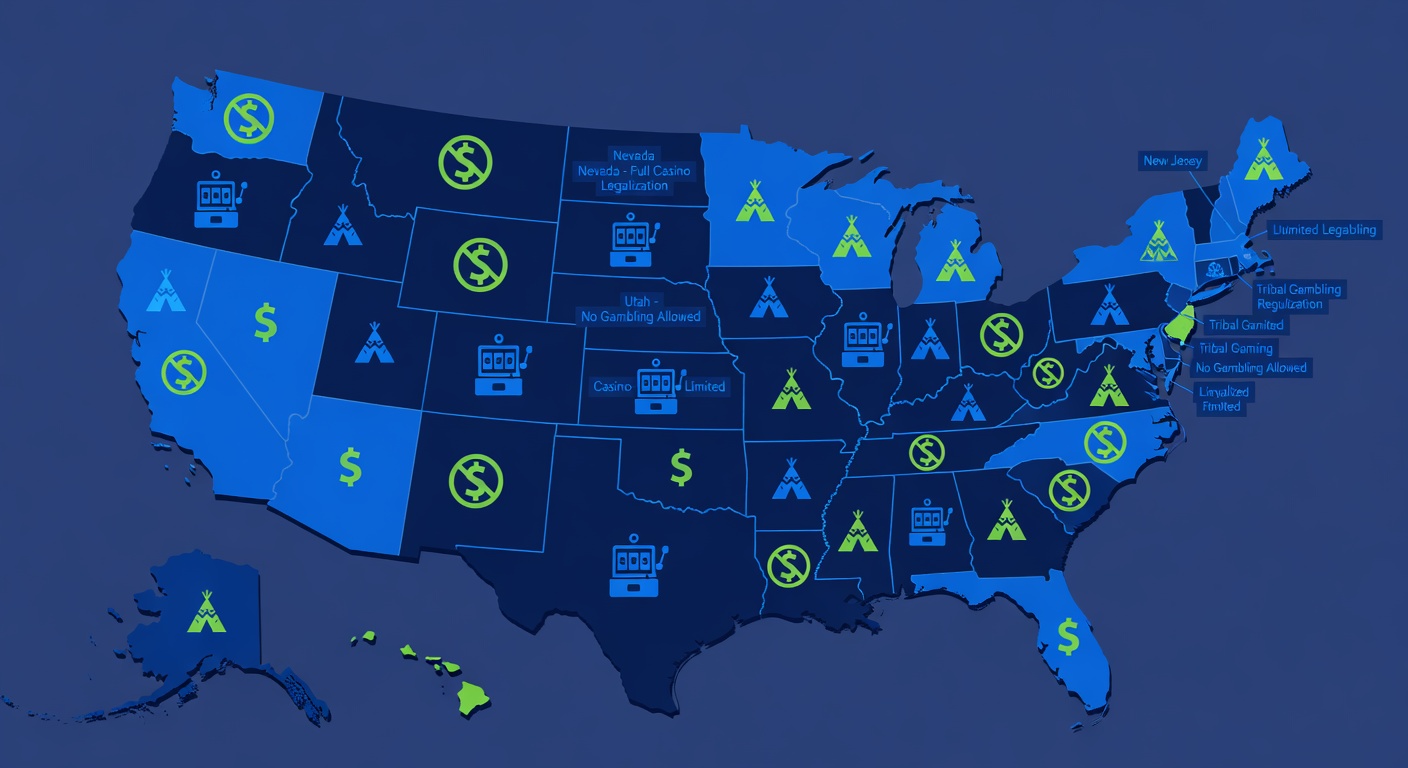
Today, every state is allowed to set its own gambling policy. Some prohibit it outright. Some allow it completely. Most fall somewhere in between. This creates a situation where a resident of one state might have access to twelve different legal sportsbooks and online casinos, while a resident of another state has zero. The person living two miles away, just across a state line, has completely different options.
Nevada, the Original
Nevada legalized online gaming in 2013, before anyone else. The state had a history of gambling, so it made sense that Nevada would move first. Nevada's approach was permissive. An operator like DraftKings could apply for a license, demonstrate that it had adequate player protection and that its random number generators were certified (RNG certification, usually through third-party testing companies like GLI), and then operate. The state imposed a tax on gross gaming revenue, which varies by game type but usually runs 6-15 percent. A player in Nevada has access to most major sportsbooks and a growing number of online casinos.
New Jersey and the Boom
New Jersey came next in 2014. New Jersey's approach was different: it required operators to partner with an Atlantic City casino. This was a way to protect existing casino interests. If you want to offer online blackjack or roulette in New Jersey, you need to be licensed and you need a land-based partner. This partnership requirement made things slower, more expensive, and generally less frictionless than Nevada. But it ensured that revenue flowed to Atlantic City operators, which was the point.
How State Systems Actually Work
Most states that allow online gambling follow one of three patterns. First, the proprietary-license model: the state grants licenses to individual operators who meet criteria. Bet365, DraftKings, FanDuel, and BetMGM all have individual licenses in states that use this model. The operator pays an application fee (can be thousands of dollars), submits to a background check, certifies that its systems meet security standards, and then operates subject to ongoing audits and reporting requirements. This is what most states use now because it is the simplest to administer.
Second, the partnership model: like New Jersey, where an online operator must partner with an existing licensed brick-and-mortar operator. This is rarer now because it slows down the market.
Third, the monopoly model: one state-run or state-selected operator handles all sports betting or all gaming. This is uncommon in the US but more common in Europe. No US state uses pure monopoly currently.
Licensing and Regulation
When an operator applies for a license in a state like New York, Pennsylvania, or Illinois, the state's gaming regulator (usually called the Gaming Commission or Gaming Control Board) reviews the application. They check:
- Proof of financial stability
- Background checks on executives
- Certified RNG systems (random number generation for all games)
- KYC protocols (know-your-customer identification)
- AML systems (anti-money-laundering compliance)
- Responsible gambling tools (deposit limits, time-out features, self-exclusion)
- Server location (many states require servers to be physically located in the state)
- Tax compliance
If approved, the operator gets a license. The license is not permanent. It requires annual renewal, ongoing audits, and compliance with any new regulations the state introduces.
Taxation
Taxation is where the incentives get weird. A state taxes gaming revenue (the amount the operator keeps after paying out winners). This is different from taxing the player. A state like Pennsylvania might tax a sportsbook at 36 percent of gross gaming revenue for sports betting and higher for casino games. This is the operator's problem, not the player's. The player does not see the tax directly.
But the tax rate affects whether an operator wants to enter a state. A state with a 40 percent tax rate might not attract as many operators as a state with a 20 percent rate. So states compete on tax rates. Lower taxes attract more competition, which means more options and (in theory) better odds for players.
Age Verification and Identity
Every state requires age verification. You cannot play unless you are 21 (or sometimes 18 for sports betting). This is enforced through ID verification at signup, usually via the player submitting a photo of their driver's license. Some operators require third-party verification through services like Clarity or Socure.
Geolocation is also required. If you live in a state that prohibits online poker, you cannot play poker there, even if you have an account with a licensed operator in another state. This is enforced through IP geolocation (checking your location) and sometimes through phone location when you are using a mobile app. The systems are not perfect, but they work most of the time.
Interstate Compacts
Some states have signed agreements that let players in different states play against each other. This is called an interstate compact. The biggest one is the Multi-State Poker Compact, which lets players in Nevada, Delaware, and New Jersey play online poker together. This increases the player pool, which increases game quality and decreases rake. But not all states participate, so interstate play is limited.
The Practical Reality
If you live in Pennsylvania, you probably have access to 8-12 legal sportsbooks and 4-6 legal online casinos. If you live in Idaho, you have zero. If you live in Utah, same thing. If you live in Ohio or Michigan, you have more options. The law is not uniform. It is state-by-state friction.
This system exists because the US Constitution reserves most regulation to the states, and because when the internet arrived, nobody had a federal scheme ready. The result is a patchwork. It is not elegant. But it is the system we have, and it is unlikely to change because states benefit from the tax revenue and the ability to set their own terms.