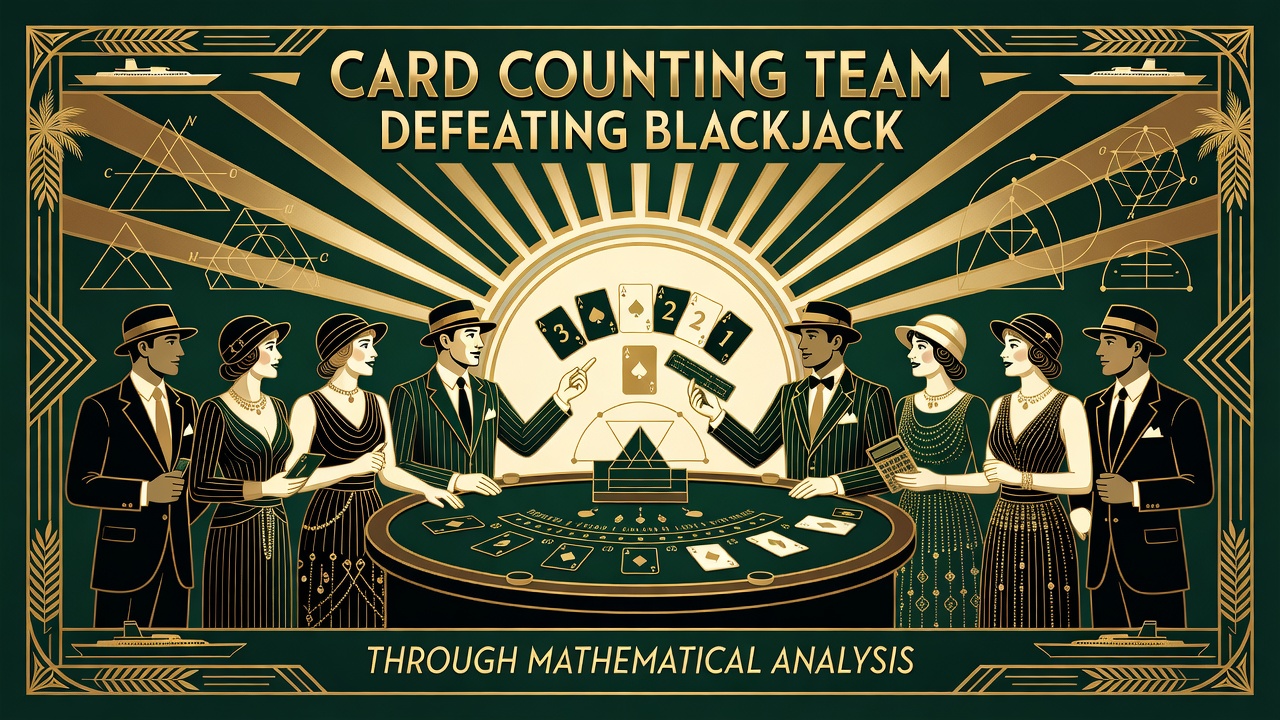
I didn't understand what Tommy Hyland was doing when I first heard about the blackjack team. A group of people counting cards, playing together, pooling profits? It sounded like cheating, except it wasn't. It was mathematics applied to a vulnerable game.
Hyland's team operated from roughly 1980 to 1995. They used card counting (tracking the ratio of high to low cards remaining in the deck) and bet sizing (wagering more when the count was favorable) to achieve what appeared to be impossible: sustained winning at blackjack. Some members of the team allegedly won hundreds of thousands of dollars during their operation.
The team worked because they understood something casinos took for granted: blackjack has an exploitable weakness. A single deck dealt many times before reshuffling creates statistically visible patterns. With sufficient capital and discipline, a skilled counter can win.
How It Worked
The system was systematic but not complex. Members of the team would sit at different blackjack tables, each playing basic strategy (the mathematically optimal plays for every hand combination). One member, the "spotter," would count cards without betting large. When the count became favorable, they would signal another team member (the "big player") to join the table and bet heavily.
From the casino's perspective, a big player arriving suddenly, betting large amounts, and then leaving created a pattern. But it was a difficult pattern to prove as cheating. The player was making legal moves, wasn't doing anything physically illegal, and was simply lucky at the right time.
Over thousands of hands and months of operation, the team's mathematical edge compounded. A two percent edge per hand, played repeatedly, generates consistent profit.
Why It Matters
The MIT Blackjack Team (the academic name used later in the 1990s) proved that casino games are not mathematically fixed. There is always, somewhere, a vulnerability. Blackjack's vulnerability was the reshuffle point. Baccarat's vulnerability (if it exists) would be different. The point was that the house edge is not inevitable; it is a product of specific game design.
I learned about this team late into my own problem gambling, and it changed how I thought about games. I had been playing blackjack "hoping" to win, using intuition and superstition. The team played knowing they would win, using math and patience.
The Countermeasures
Casinos responded predictably. They reduced penetration (reshuffled more frequently), banned suspected counters, and hired countermeasure specialists to identify advantage players. By the mid-1990s, the conditions that allowed the team to operate had largely been eliminated.
This is important: the team's success led directly to the countermeasures that made similar success harder for future players. The casino industry learned. Now, if you're observably winning too consistently, casinos will ask you to leave. Suspected advantage players are backed off.
My Relationship to the Story
When I first heard about the team's success, I thought, "I could do that." I thought I could learn card counting, join a team, beat blackjack. In reality, I had neither the bankroll, the discipline, nor the emotional stability to operate as an advantage player. I wanted the win without the work.
The team's story helped me understand what I was doing wrong. I was playing with hope instead of math. I was treating gambling as a lottery instead of a system. The team played with perfect discipline because they understood that discipline was the entire edge.
It took me years and significant losses before I genuinely internalized that lesson. The team's success was mathematically sound but psychologically exhausting. They won by being emotionless, calculating, patient. I was the opposite. Their story, understood deeply, explained why I couldn't replicate it.