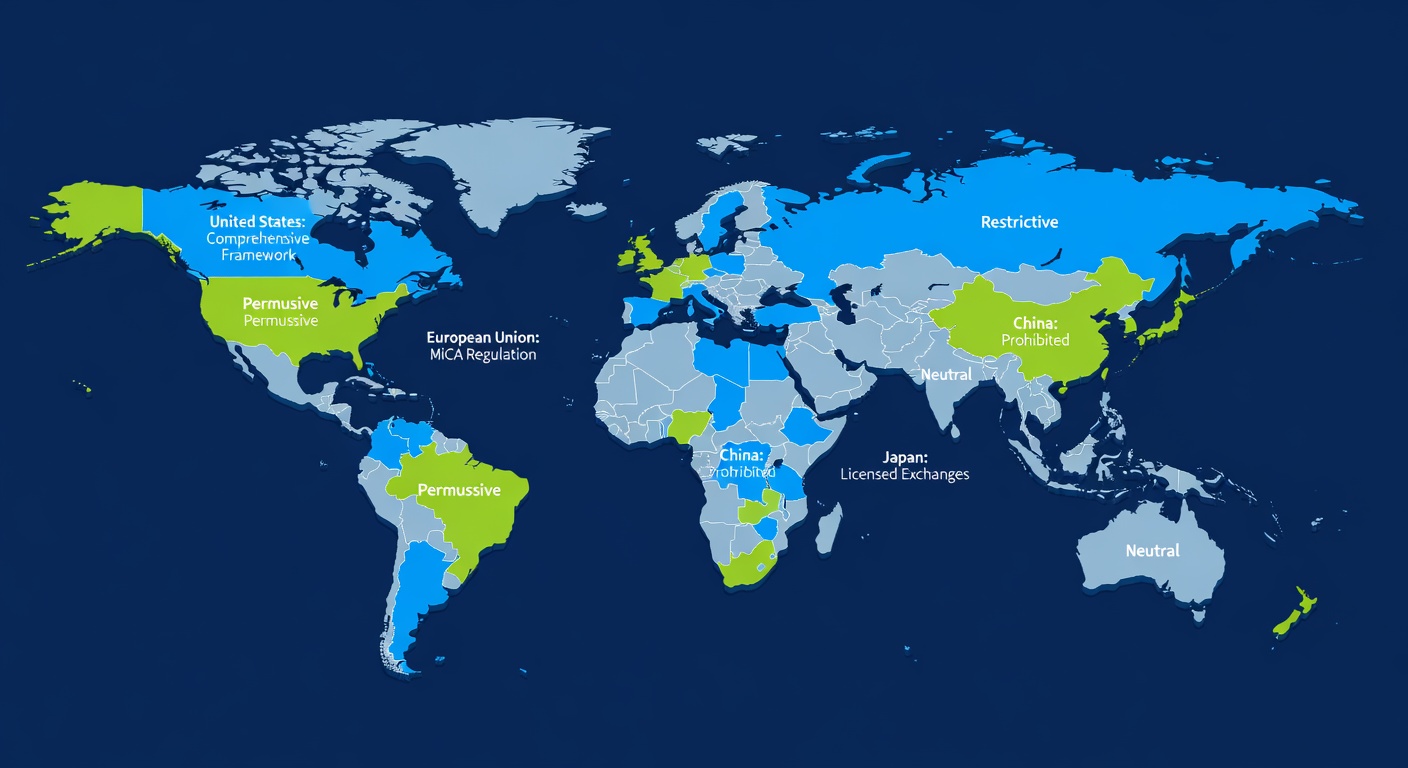
The fragmentation in crypto gambling regulation is not chaotic accident. It is the result of coherent but contradictory assumptions about what crypto gambling is and where it belongs in the legal system.
The Core Problem
Crypto gambling sits in a gap between two regulatory regimes. Is it gambling (and thus subject to gaming commissions)? Or is it financial services (and thus subject to banking regulators and money-laundering rules)? Or is it technology (and thus subject to data protection and consumer-protection rules)? Different nations answer this question differently, and the answer determines the entire regulatory framework.
The USA Approach
The United States has delegated gambling regulation to states, and crypto regulation to a fragmented set of federal agencies (SEC, CFTC, FinCEN). This creates a situation where crypto gambling is simultaneously unregulated (because no state explicitly permits it) and heavily scrutinized (because FinCEN treats it as a money-transmitter risk). The result is that crypto casinos operate in a gray zone. They do not explicitly violate federal law, but they also cannot legally operate with a license. So they operate offshore and serve Americans illegally.
The regulatory response has been to pressure payment processors and crypto exchanges to delist gambling services. Kraken delisted US-facing gambling products. Binance did the same. The effect is to make it harder for Americans to fund offshore gambling, without explicitly banning the activity.
The EU Approach
The European Union treats crypto gambling as gambling first, financial services second. Each member state has gambling authority (Ireland has one framework, the UK has another, Malta has a third). Some, like Malta, have created specific crypto gambling licenses. The MGA (Malta Gaming Authority) issues licenses to crypto casinos that meet KYC, AML, and responsible-gambling requirements. This is regulatory acceptance with oversight.
Other EU states ban crypto gambling outright. Germany has restrictive rules. France has its own framework. The EU itself has not harmonized, so a crypto casino licensed in Malta cannot automatically operate in Germany.
The Asia-Pacific Approach
Australia treats crypto gambling as gambling and has applied its existing gambling framework to crypto. The result is that offshore crypto casinos are prohibited from advertising to Australian players. Domestic operators must comply with state-by-state licensing. The approach is exclusionary; Australia is trying to keep the market small and regulated.
Philippines takes a different approach. It licenses crypto casinos and treats them as economic engines. The Philippine Amusement and Gaming Corporation (PAGCOR) and the Cagayan Economic Zone Authority (CEZA) issue licenses to offshore crypto casinos that do not target Philippine residents. This is regulatory acceptance for export revenue.
The Mechanism of Fragmentation
The fragmentation persists because:
- Regulatory capture is hard. No nation has a coherent crypto industry that can lobby for a specific framework, so regulation is reactive rather than proactive.
- Crypto's technical nature confuses traditional regulators. Is USDT a currency? A security? A commodity? Different agencies answer differently.
- Cross-border nature of crypto. A crypto casino licensed in Malta can serve players in 50 countries simultaneously. Individual regulators cannot solve this alone.
- Conflicting goals. Some nations want tax revenue from gambling (suggesting legalization and licensing). Others want to reduce problem gambling (suggesting prohibition). These goals are in conflict.
The Evolution
There is a trend toward clearer regulation. The EU's AMLD5 directive (Anti-Money Laundering Directive) has pushed member states toward clearer frameworks. The FATF guidance on crypto-gambling has created a baseline, though not binding. Over time, regulation will likely move toward one of two poles: either explicit licensing frameworks (like Malta) or explicit prohibition (like some EU states). The middle ground of "unregulated gray zone" is unstable and tends to resolve.
But for now, crypto gambling remains fragmented because the underlying technology is still contested. Is it cash? Is it money-laundering risk? Is it speculation? Is it a commodity? Until nations answer these questions consistently, regulation will remain fragmented.