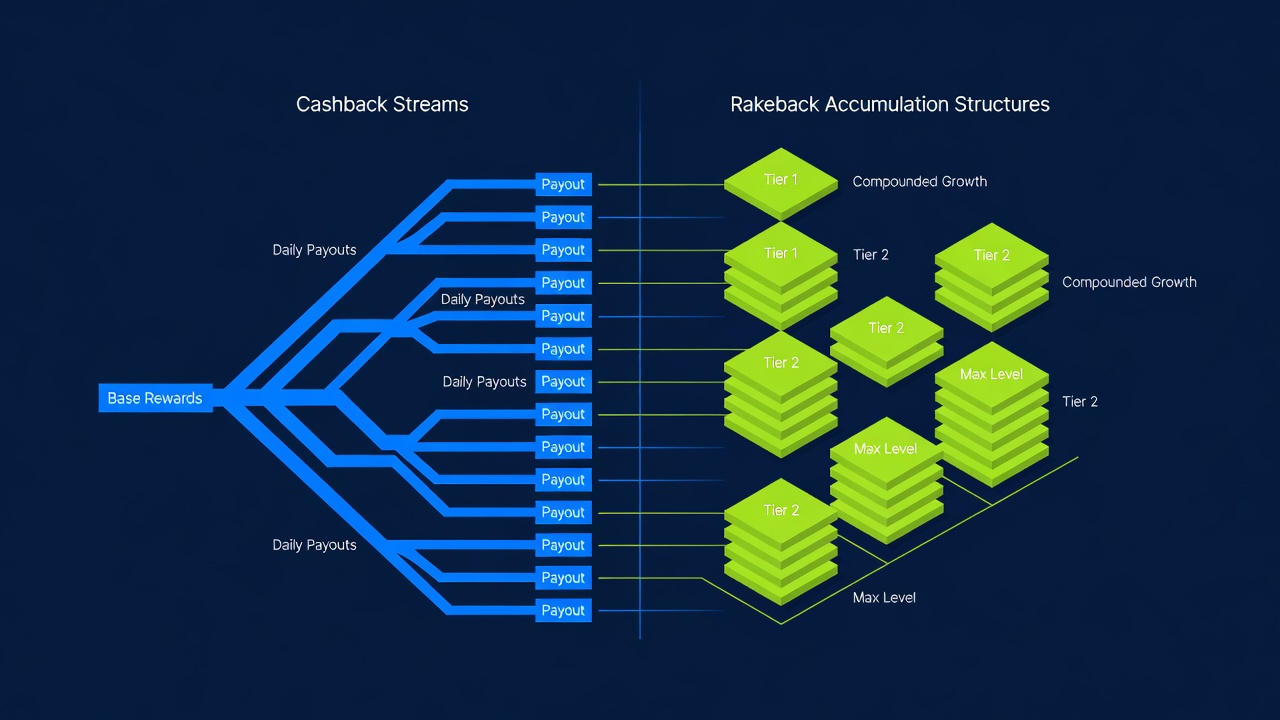
Cashback and rakeback sound identical until you examine the mechanics. Both return a percentage of your losses. Both arrive after you've finished playing. But the calculation methods differ, and those differences compound over time.
Cashback is calculated on your net losses. If you deposit $1,000, play until you have $800 left, your loss is $200. Cashback at 10% pays you $20 back. The calculation is transparent: loss times percentage equals payment.
Rakeback is calculated on the "rake," which is the commission the operator extracted from pots or spreads. In a poker-style game, every hand generates rake. If you played $10,000 in total hand value and rake was 3%, the operator extracted $300. Rakeback at 30% of rake pays you $90.
The difference: cashback is calculated on your money; rakeback is calculated on the operator's commission. In poker specifically, you might play $10,000 of action (money moving between players) but only lose $800 personally. Cashback pays on the $800. Rakeback pays on a percentage of the $10,000. Rakeback typically pays more in poker contexts.
Testing the Mechanics
Scenario: You play poker at a crypto casino for a week. You play fifty $20 buy-in games, losing an average of $50 per session. Total loss: $2,500. Total action generated: $50,000 (assuming each game involves $1,000 in pot movement before elimination).
Cashback at 5%: pays $125 (five percent of $2,500 loss). Rakeback at 1% of action: pays $500 (one percent of $50,000 action).
Rakeback appears dramatically superior. But it's calculated differently. Rakeback assumes you're generating high-volume action. If you play tighter and generate less total action (high-value pots that move less), rakeback decreases. Cashback remains constant relative to your loss.
The Operational Reason
Crypto casinos use different bonus structures to target different player types. Rakeback appeals to high-volume grinders who play many hands quickly. Cashback appeals to casual players who play fewer sessions and care about percentage return on losses.
Operators also track which bonus structure costs them less in expectation. If most players playing for rakeback generate $5,000 in action monthly and pay 1% rakeback, that's $50 per player. If most players playing for cashback lose $500 monthly and pay 5% cashback, that's $25 per player. The operator can then price the two programs accordingly: offer higher rakeback to attract grinders, lower cashback to fill seats with casuals.
Which Should You Choose
This depends on your play pattern. If you play many hands, generate high action volume, and stay engaged, rakeback is superior. If you play fewer, larger sessions, the action volume might not be high enough to justify rakeback, making cashback better.
The honest assessment: both are subsidies on losses, not profit. A player with negative expected value remains negative expected value, rakeback or cashback. You're reducing your rate of loss, not reversing it.
Comparative Analysis
| Factor | Cashback | Rakeback |
|---|---|---|
| Calculation | Net losses | Action generated |
| Transparency | High | Lower |
| Best for | Casual play | High volume |
| Predictability | High | Variable |
| Gaming math impact | Reduces loss % | Reduces effective rake |
Both structures are real value transfers from operator to player. Which one benefits you depends entirely on whether you generate more profit from percentage-of-loss or percentage-of-action.