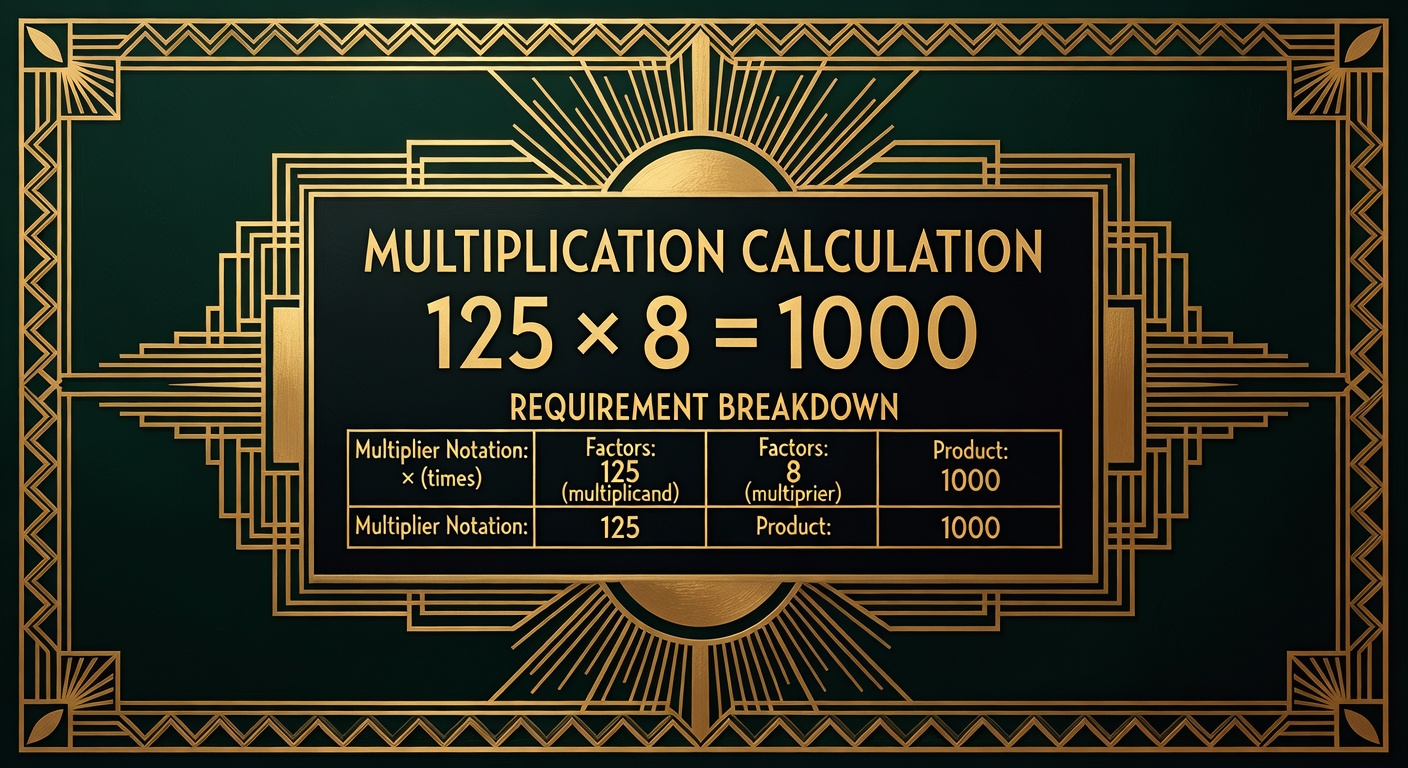
CLAIM: If I get a $100 bonus with a 30x wagering requirement, I need to wager $3,000 to unlock the bonus.
REALITY: You are correct about the calculation. You also comprehensively misunderstand what it means. The $3,000 in wagering does not guarantee you will access the bonus. It requires that your cumulative bets equal $3,000, but the outcome of those bets determines whether the bonus is released.
Let me be precise about the mathematics. You receive a $100 bonus. This bonus is credited to your account. You cannot withdraw it until the wagering requirement is satisfied. The requirement is 30x, which means you must place bets totaling $3,000. This is the sum of all bet amounts, not your net loss or gain.
If you place a $10 bet and win, that $10 counts toward the requirement. If you place a $10 bet and lose, that $10 also counts toward the requirement. The requirement is about bet volume, not outcome.
The Implicit Probabilities
Assuming standard casino games with typical house edges: let us say you are playing slots with an RTP of 96 percent. For every dollar wagered in expectation, you lose 4 cents. Across $3,000 in wagering, your expected loss is $120. You received a $100 bonus. Your net expected position is negative $20.
Therefore, a $100 bonus with 30x requirement is equivalent to a gift of negative $20 in expectation. You are not receiving free money. You are receiving $100 that you then burn off through expected play losses, except the burning exceeds the gift.
This is the baseline math that casino operators understand and players often do not. The bonus appears generous. The wagering requirement appears reasonable. The combination is engineered so that the expected value of the bonus to you is negative.
Different Games, Different Edges
Some games contribute "100 percent" toward the wagering requirement, others contribute less. If you play a game with higher house edge (like single-zero roulette at 2.7 percent), your expected loss across $3,000 wagering is $81. The bonus is now worth $19 in expected terms. Better, but still negative.
If the casino restricts high-RTP games from the bonus, they force you to play games where the math is worse. If blackjack (house edge 1 percent) contributes only 50 percent toward the requirement, while slots (house edge 4 percent) contribute 100 percent, the casino is incentivizing you to play the higher-edge game. This is deliberate design.
Some operators implement "conversion caps": once your bonus reaches a certain size relative to your original deposit, further play does not generate more bonus. Others implement "max bet" restrictions: you cannot place bets above $5 or $10 while clearing a bonus, which extends the time and therefore the variance.
The Time Cost
Clearing a $100 bonus with 30x requirement at $10 per hand takes 300 hands. At 60 hands per hour (a conservative rate for slots), this is five hours of continuous play. Most people cannot play continuously. This extends to multiple sessions. During these sessions, you are exposed to variance. You might get lucky and finish above expected value, or unlucky and finish below.
The casino's interest is not in your immediate outcome on this bonus; it is in your retention as a player. If you clear the bonus, you have now spent five hours in the casino ecosystem, become familiar with specific games, and established a playing pattern. You are more likely to return. The bonus is a customer-acquisition tool disguised as a gift.
When Bonuses Might Be Worth Playing
Bonuses are worth playing if two conditions hold. First, the game you are forced to play has an RTP above 96 percent, which is rare. Second, you would have been going to play that amount anyway, and the bonus effectively subsidizes that play. If you were planning to play $3,000 at slots anyway, getting $100 handed to you first reduces your expected loss slightly.
But the casino banks on the fact that most players would not be playing $3,000 without the bonus. The bonus creates artificial action. Therefore, most bonuses are value transfers from player to casino, measured in expectation, before any luck is involved.