The reverse withdrawal. The button every grinder knows about, and every honest grinder hates.
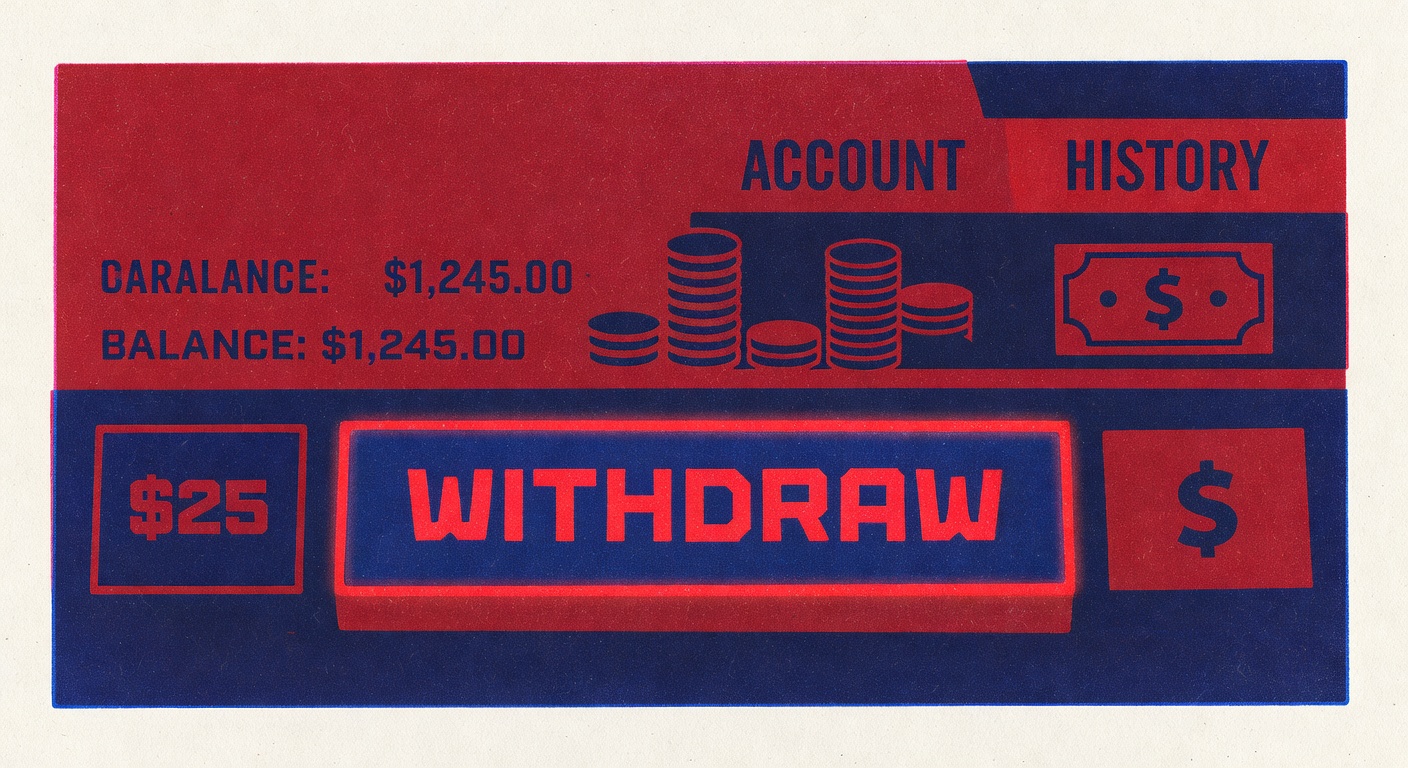
Here is what it is. You win. You hit withdraw. The casino puts the funds into a pending state for a few hours or a few days, depending on the operator. During that pending window, if you log back in, you see your money and a button that says reverse this withdrawal. One click and the funds are back in your playable balance. You can bet them again.
You can see the problem from where I am sitting. Let me walk you through how it got here.
Late 1990s: The Feature Arrives
The earliest online casinos, in the window from roughly 1996 to 2000, were built on gaming platforms developed by a handful of software companies. Microgaming, Boss Media, Playtech, Cryptologic. The reverse withdrawal feature was built into the core of several of these platforms at the outset. Not as a player protection. As a customer service tool.
The reasoning at the time was that withdrawals took days. Wire transfers to American and European banks, in 1999, were slow. Players who had requested a withdrawal and then changed their minds, because a game had opened up or a promotion had launched, would have to contact support, wait for a human to process the reversal, and then play. The reverse withdrawal button was the self-service version of that customer service request.
The designers were thinking about the player who wanted to keep playing. They were not thinking about the player who had requested the withdrawal for a reason that deserved to stand.
2000 to 2005: The Boom Years And The Tilt
The growth of online poker and online casino play in the early 2000s produced a generation of players who, for the first time, were managing sizable balances on internet accounts. Winners cashed out. Losers, most of them, lost what they had deposited and moved on. A subset of losers, however, did something new.
They won, they cashed out, they sat at the table through the pending window, they watched the balance sit there, and they reversed the withdrawal. They played the money back. This was not, broadly speaking, a reasoned decision. It was a tilt response, sometimes after a period of sustained loss that the player was trying to recover from, sometimes after a period of sustained win that the player was trying to extend. The reverse withdrawal button made the tilt decision frictionless.
The casino operators of the period, it must be said, were not entirely unaware of this. The feature stayed. The pending windows got longer at some operators (24 hours, 48 hours, occasionally 72 hours) while shorter at others. The button remained in the account portal, one click away from the balance screen. The feature was, in customer retention terms, enormously effective.
2005 to 2012: Early Regulatory Awareness
The first gaming regulators to examine the reverse withdrawal feature as a player-protection issue were in the United Kingdom and Scandinavia, roughly in the second half of the 2000s. The Gambling Commission's earliest guidance documents, issued after the 2005 Act came into force in September 2007, did not specifically name reverse withdrawals, but the general framework of treating customers fairly provided a hook for regulator scrutiny.
The Kindred Group, operating under several brand names, was among the first major operators to remove the reverse withdrawal feature from its default UK-facing product, around 2011. Paddy Power followed around 2012. The removals were presented publicly as customer-protection measures.
Other operators, especially those targeting jurisdictions with lighter regulatory regimes, retained the feature. The long tail of offshore casinos, accessible to players in markets without local regulation, generally kept the feature throughout this period and, in many cases, keeps it still.
2014 to 2019: The UK Ban
The specific regulatory action that meaningfully changed the landscape was the United Kingdom Gambling Commission's 2018 LCCP amendment, which required licensees to ensure that customers had a reasonable opportunity to complete withdrawals without diversion back into play. The technical requirement, implemented in stages through 2018 and 2019, was that reverse withdrawal functionality be removed from UK-licensed operators' products, or be presented in a way that did not default to retention of funds in the playable balance.
The industry response was mixed. Major operators serving the UK market complied. Some complied grudgingly, moving the reverse option to a customer service contact process rather than a one-click button, which reduced the friction only modestly. Others removed the feature entirely and reframed the pending window as a fixed irrevocable hold, which is, from a player's perspective, the cleaner outcome.
Sweden's Spelinspektionen, when it took over licensing of Swedish online gambling in January 2019, adopted a similar position. The Netherlands, when its Kansspelautoriteit licensing regime began in October 2021, likewise required withdrawal requests to be processed without default diversion.
The Offshore Picture, 2020 Onward
In the regulated European and United Kingdom markets, reverse withdrawals are now largely gone, or have been restructured into processes that are no longer the one-click trap they were. The picture at offshore operators, at licensees in jurisdictions with lighter regulation, and at crypto-native casinos that operate without national licensing entirely, is different.
At those sites, the reverse withdrawal feature frequently persists. The pending window, sometimes extended to three to seven days, creates a long interval during which the player can change their mind. The casino's customer service may, in some cases, actively prompt the player to reconsider, framing the outreach as a courtesy.
For a player whose game is skill-based (card counting, advantage play, positive-EV promotion hunting), the reverse withdrawal feature is not neutral. It is a cost. Every session that ends with a win and a subsequent reversal of that win is a session in which the expected value of the advantage play was not realised. The session's outcome, viewed through the lens of the player's long-term hourly rate, becomes negative rather than positive, and the pattern repeats across sessions until the advantage player either learns to treat the withdrawal button as irrevocable in their own mental accounting or accepts that the feature has converted their advantage into a cost.
The Present Day
As of this writing, the reverse withdrawal feature remains available at most offshore and crypto-native online casinos and is no longer available at most regulated European and United Kingdom operators. The split corresponds, approximately, to the split between markets with affordability-led regulation and markets without.
The practical guidance, for a player operating in a jurisdiction where the feature exists, is narrow and has not changed since the grinders of 2002 started passing it around. Treat the withdrawal request as irrevocable once you have made it. Log out of the account during the pending window. Do something else. The balance will clear. The money will arrive.
The feature is not, in the modern regulated environment, a feature any responsible operator chooses to build new. It is a legacy piece of plumbing from the era when online gambling was a younger, less-examined industry, and it persists in the corners of the industry that have not been forced to remove it. A player who understands the history understands why the button is where it is, and why the right move, regardless of jurisdiction, is to treat it as if it were not there at all.