You enter a poker tournament. Two hundred players at $100 buy-in. The prize pool is $20,000. Now the casino faces a distribution problem: how do we split $20,000 among players who finish in different positions? The answer reveals how casinos manage their exposure and player expectations.
The simplest structure is what's called a "flat" payout: everyone who finishes in the money gets equal share. Two hundred players, twenty finalists each get $1,000. But this punishes depth of skill. The player who outplayed the entire field and finished first receives the same as the player who barely survived to the money. This structure is rare because nobody would believe it's fair.
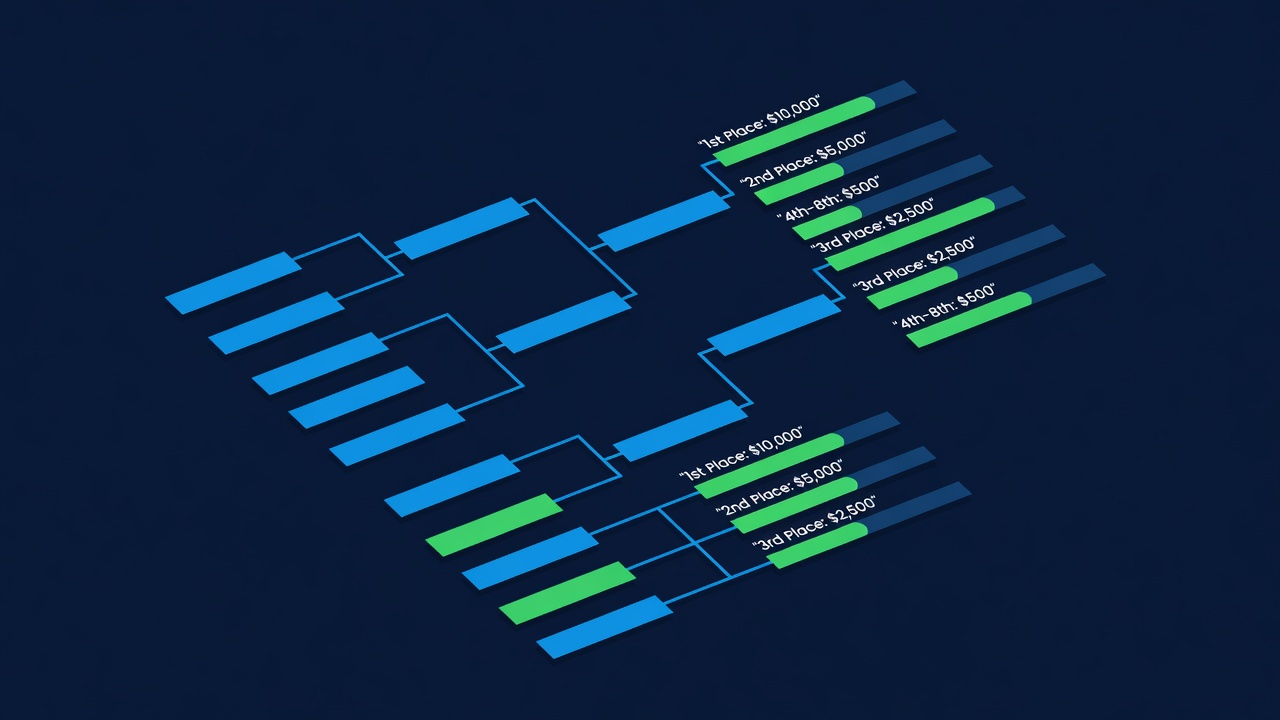
The standard structure is "graduated": prizes increase steeply as you move from the bubble toward first place. A typical payoff ladder for a tournament with 200 entrants might look like this: first place gets $8,000 (40% of pool), second gets $4,000 (20%), third gets $2,000 (10%), fourth through sixth get $1,000 each, seventh through tenth get $600 each, eleventh through twentieth get $300 each. The pool is exhausted; all finalists are paid.
The Math Behind the Structure
Why this distribution? First, the casino is not paying from the prize pool. The casino has already taken a "rake" before the prize pool calculation. If two hundred players each put in $100, the casino typically takes fifteen to twenty percent before distributing the remainder as prize pool. The remaining $16,000 to $17,000 is divided among finalists. The casino's cut is silent; you never see it. You only see the available pool.
Second, the graduated structure matches player psychology. A player who barely makes the money gets compensation for surviving to the finish line. A player who dominated gets disproportionate reward. First place wins more money than finishing second by a significant margin. The ratio matters: if first place paid three times what second place paid, more people would grind toward final tables. If first place paid ten times what second place paid, only serious players would enter.
Casinos calibrate this ratio to maximize total buy-ins whilst staying within norms that players accept. If the ratio is too steep, casual players feel priced out. If it's too flat, serious players take their money elsewhere.
The Chip Chop Complication
Players at the final table sometimes negotiate a "chip chop": they agree to divide remaining prize money based on chip stacks rather than continue playing. This is legal in most casinos, though some prohibit it. A chip chop preserves expected value: the player with the most chips gets the largest payout even if they lose the final hand. Casinos tolerate chip chops because they reduce the length of tournaments (good for casino efficiency) and because they avoid the statistical anomaly where a skilled player loses all their chips to a lucky hand at the end.
Why Payout Structures Matter for Players
Understanding the structure matters because it affects strategy. In a flat payout structure, you're indifferent between finishing with average chips or great chips; you get the same prize. You should play conservatively and simply survive. In a graduated structure with steep first-place premium, you should play aggressively once you've made the money, because the additional chips are worth exponentially more than your current payout guarantee.
A casino security perspective: graduated payouts protect the casino from long tournament runs. If final tables commonly lasted twelve hours, the casino incurs facility costs. If the first-place prize is large enough that aggressive play ends tournaments faster, the casino saves money. This is subtle incentive engineering.
The most common structure is what's called "ICM" (Independent Chip Model) payout distribution. It calculates each player's expected prize based on the chip stacks assuming random elimination. This is mathematically fair in expectation but feels abstract to casual players. Casinos often use simplified structures that approximate ICM without requiring calculation. The approximation allows players to understand intuitively what they're playing for.