The D'Alembert system is elegant in its simplicity. You start with a base bet, say $10. If you lose, you increase your next bet by $10. If you win, you decrease by $10. The logic: eventually, you'll win enough consecutive hands to erase losses. The system relies on the assumption that losses and wins tend toward equilibrium.
Fibonacci does similar but uses the Fibonacci sequence. Bet $1, lose, bet $1 again, lose, bet $2, lose, bet $3, and so on, following the famous mathematical sequence. After a win, you drop back two numbers in the sequence. The theory is that the exponential growth of the sequence eventually produces a win large enough to cover prior losses.
Both systems appear mathematically sophisticated. Both rely on the same fallacy: that betting more after losses can overcome house edge. Casinos know these systems. Experienced players recognize them instantly. The reason is simple: the house edge exists on every single spin or hand, regardless of your betting amount.
The Mathematics
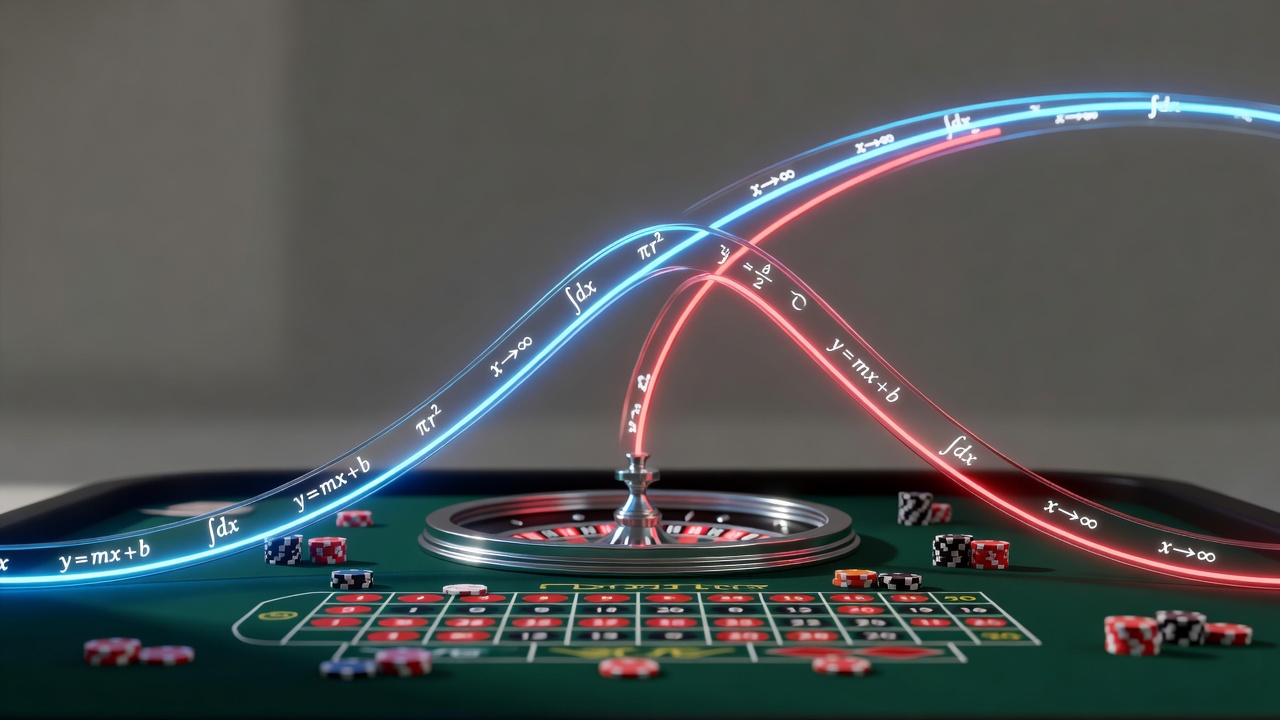
Roulette has a 2.7% house edge (European). This means that across many spins, the house profits 2.7% of total wagered amount. This edge is not negotiable. It exists per spin, per hand, per bet.
The D'Alembert system assumes that if you've lost three times, the fourth spin is "due" to be a win. This is the gambler's fallacy. A roulette wheel has no memory. The fourth spin is as likely to lose as any other spin. Increasing your bet size doesn't change the 2.7% edge per spin.
Consider a sequence: lose, lose, lose, lose, win. Under D'Alembert: $10 loss, $20 loss, $30 loss, $40 loss, $50 win. Net result: $50 total loss. The system promised to recover, but the streak was short and the win was small relative to accumulated losses.
Now consider a longer sequence: lose, lose, lose, lose, lose, win, lose. Under D'Alembert: $10, $20, $30, $40, $50, $40 (win), $50 (loss). The system fails catastrophically when the winning streak doesn't arrive or arrives too late.
Why People Use Them Anyway
Betting systems are seductive because they create the illusion of control. A player using D'Alembert believes they are using "strategy," not "gambling." The calculated increases feel like a system rather than impulse. This psychological comfort is real, even if the mathematical benefit is zero.
Fibonacci and D'Alembert also create memorable narratives. "I won two out of three sessions, the system works!" The player doesn't track long-term expected value; they remember the sessions where the system produced profit. Variance is mistaken for system validity.
The Brutal Truth
No betting system can overcome a negative expected value game. Increasing bet size increases expected losses per unit time. Over sufficient time, D'Alembert and Fibonacci both produce losses approaching the house edge's expectation.
A player waging $500 per session under D'Alembert at roulette expects to lose approximately $13.50 per session (2.7% of $500). Over 100 sessions, expected loss is $1,350. The system didn't prevent this; it merely made the journey longer and more psychologically complex.
The Live Scene
At a roulette table at 2 AM, you'll see players using some variant of these systems. The nervous energy, the careful documentation of bets, the intensity when the big bets are on the felt. The regulars recognize the system being used and watch with the kind of compassion reserved for people in denial.
The system has never saved anyone. It has only delayed the inevitable, providing the illusion of control right up to the moment when the bankroll empties.