
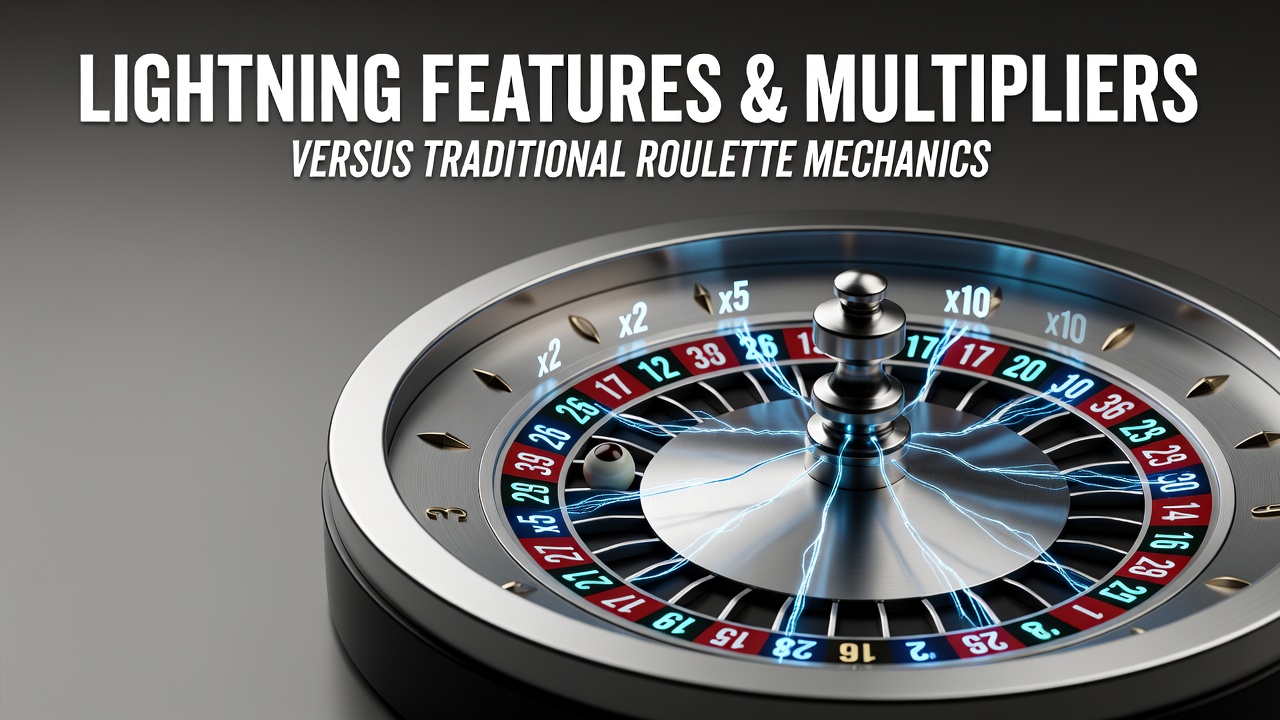
Lightning Roulette vs Classic Roulette: Is the Multiplier Worth It?
By The BonusCasino Counter4 min read
A gentleman from Zurich asked me once why anyone would choose the newer game. I had to think before answering.
Lightning Roulette arrived at the high-limit room during the pandemic pivot to live casino streaming. Evolution Gaming released it as a live-dealer variant of European roulette with a twist: before each spin, random numbers are struck by lightning and assigned a multiplier of 50x, 100x, or 500x. A player who has wagered on one of those struck numbers wins at the multiplied rate instead of the standard 35 to 1.
On its surface, this is additive. More ways to win, higher payouts possible. A person placing a five-dollar chip on seventeen and watching it struck by lightning, only to see seventeen hit and collect one hundred fifty dollars instead of one hundred seventy-five, feels fortunate. The multiplier feels like a gift.
But the gift comes from somewhere.
The Structural Trade
Lightning Roulette's house edge is 2.7 percent, identical to a European wheel. No single-zero roulette game can run at a lower edge. The mathematics forbids it. But the multiplier system requires a reduction in a different dimension.
Evolution adjusted the lightning strike probability. The lightning strikes between two and four numbers per spin, selecting from across the entire wheel. A number struck by lightning carries a multiplier. A number not struck plays at standard odds. The probability that any specific number is struck is roughly 1 in 9 to 1 in 12, depending on the specific variant.
Here is the trade: If you place a chip on seventeen and seventeen is not struck by lightning, you win at 35 to 1 if it hits. If seventeen is struck by lightning and hits, you win at 50x to 500x. But the probability of seventeen being struck is low. Most spins, the lightning avoids your number entirely.
The edge is constant. The volatility is higher. Every player is chasing the multiplier. Every player is disappointed when their number goes unlit.
The Player Sentiment Curve
In the high-limit room, I watched an industrialist from Hamburg play Lightning Roulette for three hours. He wagered on four numbers per spin, trying to increase the chance of being struck. Over three hours, he was struck once. His number, hit. He collected two hundred dollars on a five-dollar chip. Across those three hours, he had wagered two thousand dollars on four-number coverage. His multiplier hit once and paid marginally better than if Lightning Roulette did not exist.
He was thrilled. He had hit a "lightning strike." He felt like the variance had moved in his favour. The mathematics suggest he had simply played longer and chased the feature until it delivered, which is what variance does eventually.
Compare this to a customer playing classic European roulette for the same duration, same stake. They would have experienced the same long-term loss (2.7 percent) and the same sequence of wins and losses, minus the psychological theater of lightning strikes.
Lightning Roulette sells anticipation. The moment before the lightning strike is the product. The strike itself is almost secondary. The game's true value to Evolution, and to operators licensing it, is that it creates engagement through visual spectacle and the promise of variance-beating payouts that never materialize.
When the Multiplier Becomes Worth It
If a player is going to play roulette regardless, Lightning Roulette is marginally more interesting. The extra layer of visual storytelling, the chance at a higher payout, the narrative momentum of a long strike-free period followed by a hit, these are psychological amenities. They are not mathematically advantageous. The edge is identical.
There are situations where the structure matters. A player with a modest bankroll who intends to play exactly ten spins. In classic roulette, the outcomes are binary: win or lose at fixed multiples. In Lightning Roulette, the outcomes include the possibility of a much larger win on the same stake. Over ten spins, the variance is higher. A lucky multiplier hit can double the session outcome.
The multiplier is not a gift. It is a redistribution of the same edge across different moments.
But sustained play reveals the truth. The edge has not decreased. The house has merely rearranged when the loss occurs. Some spins are more visually exciting. Some numbers carry the promise of huge payouts. None of this changes the mathematical certainty that, over thousands of spins, the player will lose 2.7 percent of the total amount wagered.
A gentleman from Hamburg, or a woman from Geneva, either plays roulette or does not. If they play, they might as well play the version with better storytelling. But they should understand that the story is the entire difference. The mathematics is identical. The house edge is untouched. The only thing that has changed is the theatrical framing of the loss.
Written by
The BonusCasino Counter
The desk name on every BonusCasino guide, not a person. Guides are drafted with AI tools from terms and sources we read first, then checked by code against them before they go up.
How we write guidesBefore you claim
Multiply the bonus by the wagering requirement, then check the max-bet rule. If the daily play it needs is more than you'd bet anyway, skip the offer.
Keep reading
 Baccarat