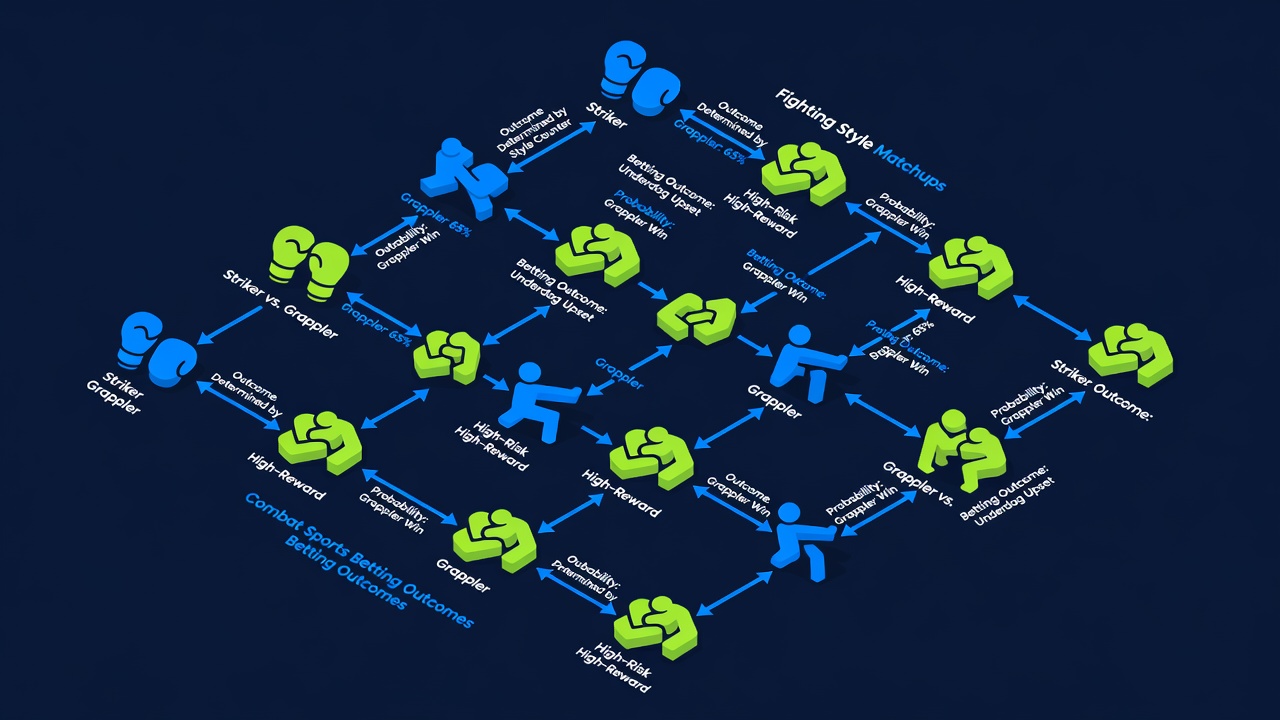
Take two fighters. Fighter A is ranked higher. Fighter B is ranked lower. Everything in sports media says Fighter A will win. The odds reflect this. You'd be stupid to bet Fighter B, right? Wrong. MMA is not boxing. Ranking means almost nothing. Specific style matchups determine outcomes with far greater reliability than any ranking or fighter record ever could.
Here's the thesis plain: the interaction between two specific styles of fighting predicts outcomes more accurately than the individual skill level of each fighter. A world-class striker who has never faced high-level wrestling can lose to a mediocre wrestler who specializes in grinding. A dominant grappler can lose to a fighter with excellent offensive wrestling and clinch fundamentals, even if the grappler is objectively the better athlete.
Why does this happen? MMA is a system where different skill trees don't add up linearly. If Fighter A is a Level 10 striker but Level 3 grappler, and Fighter B is a Level 5 striker but Level 9 grappler, the outcome depends entirely on whether the fight stays standing or goes to the ground. The ranking, which might score Fighter A as overall Level 8 and Fighter B as overall Level 6, fails to capture this crucial interaction.
The Matching Problem
Consider Israel Adesanya versus Alex Pereira. Adesanya was ranked higher. Pereira had significantly less MMA experience. By ranking, Adesanya should have won. But Pereira specialized in kickboxing against strikers, and Adesanya specializes in striking. The style matchup was brutal for Adesanya. Pereira's specific skill set countered Adesanya's specific skill set. Pereira won. The ranking predicted wrong; the matchup analysis predicted right.
Or consider any dominant wrestler facing a specialist jiu-jitsu guard player. The wrestler's ranking and record suggest dominance. But if that wrestler has never faced elite leg lock defense and the guard player specializes in leg locks, the matchup asks a different question: can the wrestler avoid the lower body? Often they can't. Ranking fails again; matchup analysis succeeds.
The profitable approach: instead of asking "who is the better fighter?", ask "does Fighter A's primary skill set have a built-in counter to Fighter B's primary skill set?" If Fighter B is a striker and Fighter A specializes in takedowns, you want to know if Fighter A has ever faced elite strikers with defensive wrestling. If Fighter B is a grappler and Fighter A specializes in clinch transitions, you want to know if Fighter B can defend the clinch.
What Vegas Misses
Odds makers use ranking as shorthand. It's faster, it's defensible, it matches casual viewer perception. A higher-ranked fighter gets better odds. This creates consistent mispricings when a ranked fighter meets someone who has a specific technical counter to their game.
Bet against ranked fighters when the matchup angles in a direction they've never had to solve before. A striker who has never faced elite wrestling, meeting a wrestler. A grappler who has never faced elite leg locking, meeting a leg lock specialist. A wrestler who has never faced elite striking, meeting a striker.
The other profitable pattern: recent tape matters more than record. If Fighter A's last three fights were against strikers and Fighter A looked dominant, but Fighter B is a grappler, the relevant data is how Fighter A looked against grapplers, not how they looked against strikers. Vegas often doesn't adjust enough for recent matchup-specific video. They weight all fights equally; you should not.
The Uncomfortable Truth
MMA betting is brutally style-dependent. This is uncomfortable for betting markets because it means rankings, records, and overall skill level matter less than specific preparation and specific technical matchups. A fighter with a 15-20 record can beat a fighter with a 20-5 record if the 15-20 fighter specializes in the exact style that breaks the 20-5 fighter's game.
This is why the same fighter can be dominant one fight and helpless the next. Not because they got worse. Because they faced someone who had built their game specifically to counter them. MMA is not a hierarchy. It's a rock-paper-scissors game played with physics and technique. The rankings pretend it's a hierarchy. The smart bettors treat it like the game it actually is.