
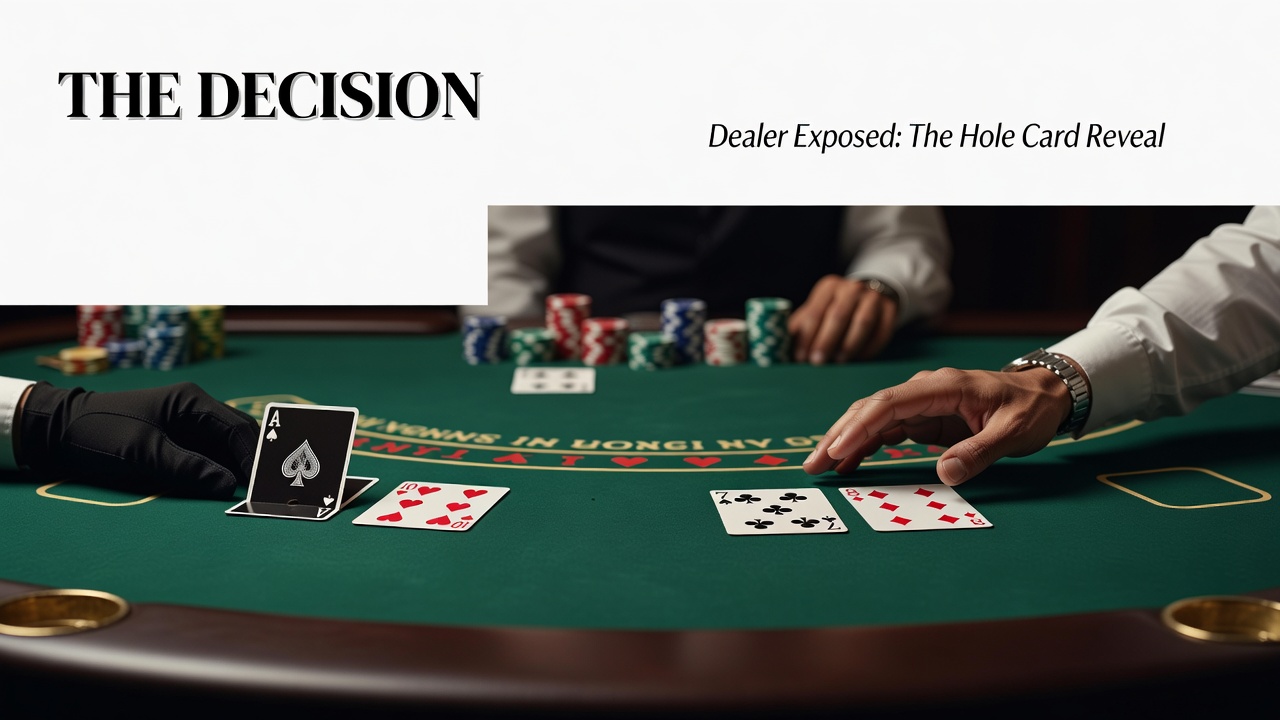
Margaret sits down at a blackjack table in Atlantic City where she can see the dealer's hole card. It should be paradise. It is not. Here is why that game exists.
Margaret was fifty-three years old and had visited Tropicana twice before. She knew blackjack well enough: basic strategy, running counts, the difference between a dealer bust and a push. She had a solid three-thousand-dollar bankroll. She was not a gambler, exactly. She was a person with discipline who occasionally did something recreational and slightly risky.
The sign above the table read "Double Exposure." Both dealer cards visible. No hidden cards. The catch should have been obvious, but casinos don't put the catch on the sign.
Double Exposure blackjack sounds like the best game ever written if you don't read the fine print. You see the dealer's hole card before you decide whether to hit, stand, double, or split. In regular blackjack, you make decisions in darkness. Your hand is twenty, but the dealer's up card is a six. Six suggests weakness, so you stand. But maybe the dealer has a face card underneath. You don't know. Double Exposure removes that uncertainty. You know everything.
But casinos don't offer games where players have advantages. They offer games where players believe they have advantages, and the house owns the difference. In Double Exposure, the catch arrives in three places.
First: pushes. In Double Exposure, if the dealer and player have identical hands, it's a push. You lose your bet. No push win, no half-win. Complete loss. In regular blackjack, a push means you get your money back. In this game, you lose it. That's seven percent of hands gone.
Second: payouts. A player blackjack (twenty-one on two cards) normally pays three-to-two. In Double Exposure, it typically pays one-to-one. You get back double your bet instead of two-point-five times your bet. That's a ninety-four-percent reduction in the upside. Over a hundred hands, that's enormous.
Third: dealer hitting soft seventeen. Some versions make the dealer hit on soft seventeen (an ace and a six). Other versions make the dealer stand. The rules vary by casino. That variation alone swings the house edge between five and six percent.
The Mathematics of Illusion
Margaret played for two hours. She made good decisions. She saw every dealer card. She felt in control. She lost seven hundred dollars. The mathematical house edge in Double Exposure is between five and seven percent, depending on the specific rule set. In regular blackjack, it's point-five percent with basic strategy. Double Exposure is thirteen times worse. Your perceived advantage (seeing the dealer's cards) is worth less than nothing, because the house reclaimed that advantage and added a massive penalty on top.
The feeling of seeing the hole card is psychologically powerful. It creates the illusion of control. Blackjack is already a game where players feel they understand the decisions. Now you have perfect information. Surely that tips the scales. It doesn't. It creates a trap: the player believes the edge is theirs, and the belief makes them willing to play a demonstrably worse game.
Information without advantage is just theater. The casino showed Margaret the dealer's cards. But they wrote the rules so that seeing them meant nothing.
Margaret asked the pit boss if the odds were different. He said yes, casually, as if explaining weather. She asked how much different. He said "a little more house edge," as if "a little" meant anything. She didn't ask how much. She wanted to keep playing because she wanted the information advantage to be real. It wasn't real. It was just a lie with better lighting.
She left Atlantic City fifty-five hundred dollars lighter than she'd planned, having won very few hands and lost very many, despite seeing the dealer's cards. She told herself the variance was unlucky. It wasn't variance. It was mathematics. The house edge was not subtle.
Double Exposure exists because it works. It exists because visible information creates psychological confidence, and psychological confidence overrides mathematical literacy. Margaret saw the dealer's cards and felt smart. Feeling smart made her willing to play a game where the house had stolen the advantage and replaced it with a theft.
Written by
The BonusCasino Counter
The desk name on every BonusCasino guide, not a person. Guides are drafted with AI tools from terms and sources we read first, then checked by code against them before they go up.
How we write guidesBefore you claim
Multiply the bonus by the wagering requirement, then check the max-bet rule. If the daily play it needs is more than you'd bet anyway, skip the offer.
Keep reading
 Blackjack