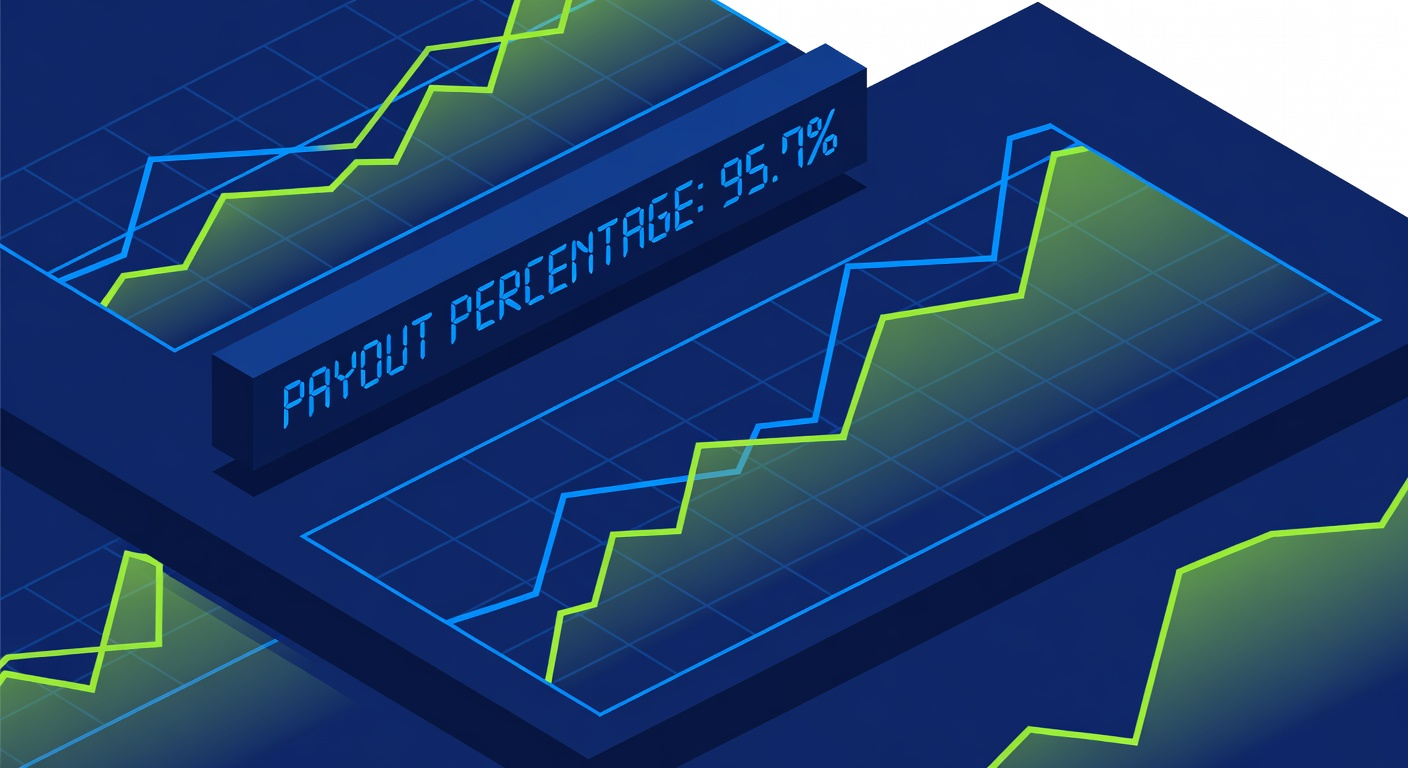
RTP means Return to Player, and it's the percentage of money that a slot machine returns to players over time. A 95% RTP means that for every $100 wagered on the machine, the casino keeps $5 and returns $95 to players as winnings. It is the single most important number on any slot machine, and it's also the number that most casinos work hardest to obscure.
How RTP Works in Practice
RTP operates over an infinite or near-infinite sample size. A slot machine with 95% RTP won't return exactly 95% over 100 spins. It might return 200%. It might return zero. The law of large numbers suggests that over 1,000,000 spins, the return approaches the stated RTP. For individual sessions, RTP is nearly meaningless.
Consider a concrete example: a slot machine with 95% RTP and a top jackpot of $50,000. The machine must be programmed such that over millions of spins, players collect exactly $95 for every $100 wagered. This programming includes the jackpot. If the jackpot hits once every 2,000,000 spins, the machine's internal computer tracks how many non-jackpot wins must occur to hit the 95% target. The house adjusts the frequency of mid-tier wins accordingly.
Elegant. Automated. Invisible to the player.
Why Casinos Hide RTP
RTP directly predicts player loss. A machine with 92% RTP will reduce a $500 bankroll to $460 on average. A machine with 97% RTP will reduce it to $485 on average. Players who understood this would obviously prefer the 97% machine. Casinos, therefore, don't publicize the 92% machines. They market the 97% machines as premium tier and hide the 92% machines in the back of the floor.
The Casino Control Commission in New Jersey requires casinos to maintain minimum RTP thresholds (typically 83-95% depending on game type). Nevada has similar rules. The European Union requires published RTP on every licensed game. But in the United States, outside of regulated states, casinos can use any RTP from 70% to 98% and players have no legal right to know which machine uses which RTP.
"A player at an unlicensed casino online has no way to know if the slot game they're playing returns 70% or 90%. Both are legal. Both are called 'fair gaming.' The difference is $40 per $100 wagered." This is not a regulatory gap. It's regulatory absence.
The RTP Tiers
Casinos manage RTP the way airlines manage seat quality. Premium players and high-volume players get access to higher-RTP machines. Casual tourists get the lobby machines, which typically run 85-88% RTP. Local players who come in regularly might get access to 92-95% RTP machines. The RTP is the same game, same rules, different payout rate in the microcode.
Most players never notice because they don't think of slots in terms of RTP. They think of slots in terms of luck. They feel lucky at one machine and move to another. The machine they felt lucky at might have been the 95% RTP machine. The machine they're moving to might be the 87% RTP machine. They attribute their changing luck to feelings when the change is actually hardwired into the machine's firmware.
What You Can Do
If you're in a regulated jurisdiction (New Jersey, Pennsylvania, Nevada, most of Europe), the RTP information is public or obtainable. Ask the casino. They're required to have it. Online casinos that are licensed in Malta, Curacao, or the UK must publish RTP data. Use it.
If you're playing at an unlicensed casino, in a state without slot regulation, or on an unregulated website, you have no actual protection and no information. The machine RTP could be 70%. It could be 98%. You don't know. This should be your cue to not play.
For someone who does choose to play:
- Prefer higher-RTP machines (96-98% over 90-92%).
- Prefer regulated casinos over unregulated ones.
- Understand that a 95% RTP machine returning 200% during a lucky streak doesn't mean you've beaten the machine. It means variance was favorable.
- Never assume a machine's RTP based on how it feels or how lucky you've been. Machines don't have memory. Your luck doesn't affect the next spin.
The Bigger Picture
RTP is the most transparent metric in gambling because the math is simple and verifiable. For every dollar wagered, a percentage returns. The inverse goes to the house. This directness makes RTP the best argument against casino slots: no amount of strategy, skill, or luck can overcome the mathematical expectation of loss.
Casinos protect RTP information because transparency kills sales. A player who knows they're playing a 87% RTP machine knows they'll lose, on average, $130 for every $1,000 wagered. That's $13 per hour on a machine running 100 spins per hour at $1 per spin. Many people would prefer not to know this. They'd rather feel lucky.
The regulatory role of published RTP is to replace feeling with data. When players know the math, they can make informed decisions about whether the cost of entertainment is worth the expense. Without published RTP, players are operating blind. Most casinos prefer it that way.