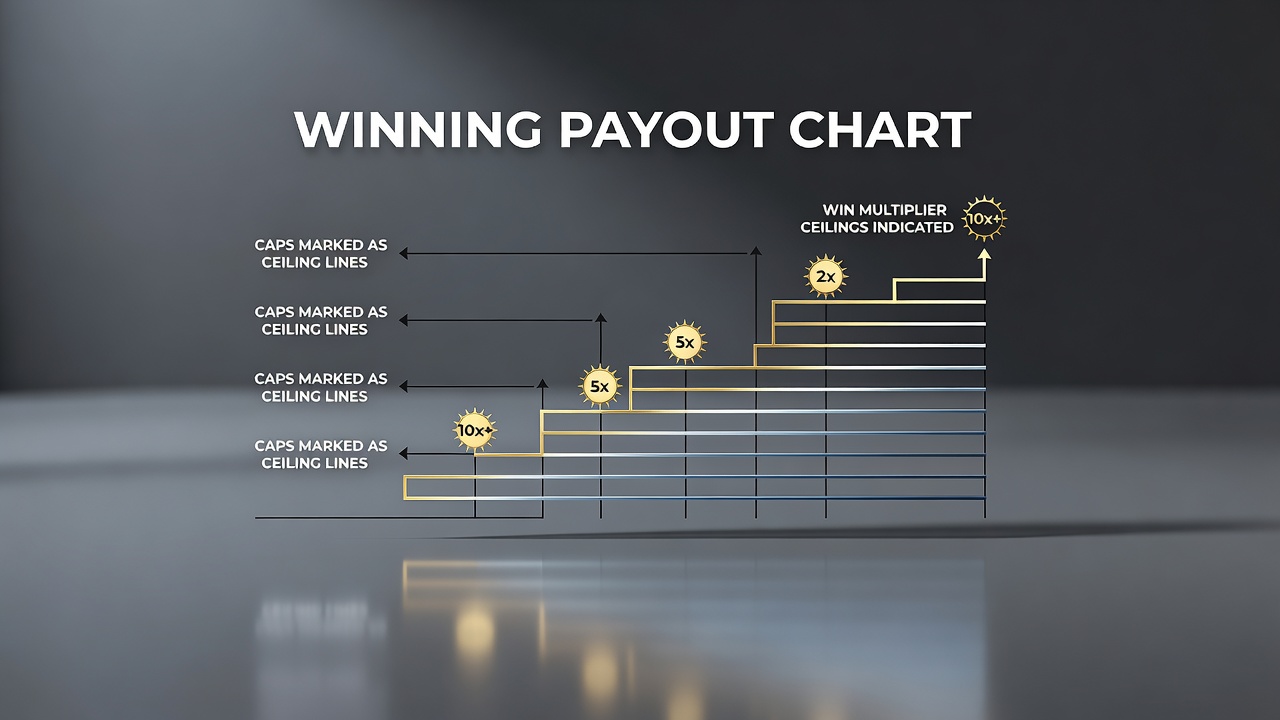
At certain machines, you will encounter what is called a "max win cap." Play for long enough, hit the right combination, win spectacularly, and your win gets capped. A machine might pay 200 times your bet maximum, or 500 times, or 1,000 times. Beyond that, you receive the cap, not the full payout.
The reason, from a regulatory perspective, is risk management. A machine's RTP (Return to Player) is a calculated expectation. If the machine is licensed for a 96% RTP, the math is done so that over millions of spins, the average player loses 4%. But a single catastrophic hit could expose the operator to enormous liability if the win were unlimited.
Consider a scenario: player bets $100 on a maximum-win-uncapped machine, hits an extraordinary combination, wins $500,000. The casino's expected profit from that player is negative. The machine's RTP calculation assumed smaller wins at higher frequency. A single massive win violates the model.
With a cap, that same hit might pay $100,000 (if the cap is 1,000x). The casino's loss is contained. The machine operates as designed. The player is still winning substantially, but within the mathematical boundary.
The Design Implication
The existence of a cap tells you something: the machine's odds favor either very frequent small wins or rare moderate wins. The machine was never designed to produce a $500,000 hit on a $100 bet. The cap prevents an outcome the machine was never intended to produce.
From a player perspective, the cap means that your life-changing win could be capped at a life-changing amount instead of a life-destroying amount. You still win, but not as much as the symbols suggest you should.
This is not unique to slots. Some poker tournaments have rules where if you accumulate enormous stacks, your stack is capped. Some casino games have maximum payouts. It is standard practice in regulated gambling.
The Fair Question
One might ask whether a capped win is fair if the player never agreed to the cap. The answer, legally, is yes: the cap is disclosed in the machine's terms. You can usually view it on screen before playing. You choose to play the machine knowing the cap exists.
Unfair would be if the cap were hidden. Some operators used to cap wins in their terms and conditions without displaying it on the machine. Regulators in Europe (UKGC, MGA) now require that caps be clearly visible. The player sees what the maximum win is before the first spin.
From a design perspective, a cap creates a perverse incentive for some machines. If the cap is too low (say, 50x your bet), the machine becomes strictly worse than an uncapped machine with the same RTP. A player comparing machines will rationally choose the uncapped one. Operators therefore price caps carefully: high enough that the machine feels rewarding, low enough to manage casino exposure.
The Philosophical Angle
A capped win is not a cap on your luck. It is a cap on the machine's obligation. The luck happens; you hit the combination. The payment is constrained by the operator's risk tolerance. What you feel as unfairness ("I hit the symbols, why don't I get the full payout") is actually the collision between machine mathematics and business strategy.