Cash games make you rich; tournaments make you broke, and here's why nobody wants to admit it. I've watched hundreds of players trade the steady cash line for the dopamine hit of tournament scores, and exactly four of them didn't eventually bust back to the register asking for a buyback. The rest went broke, got bitter, and either quit or returned to the games that built their bankroll in the first place.
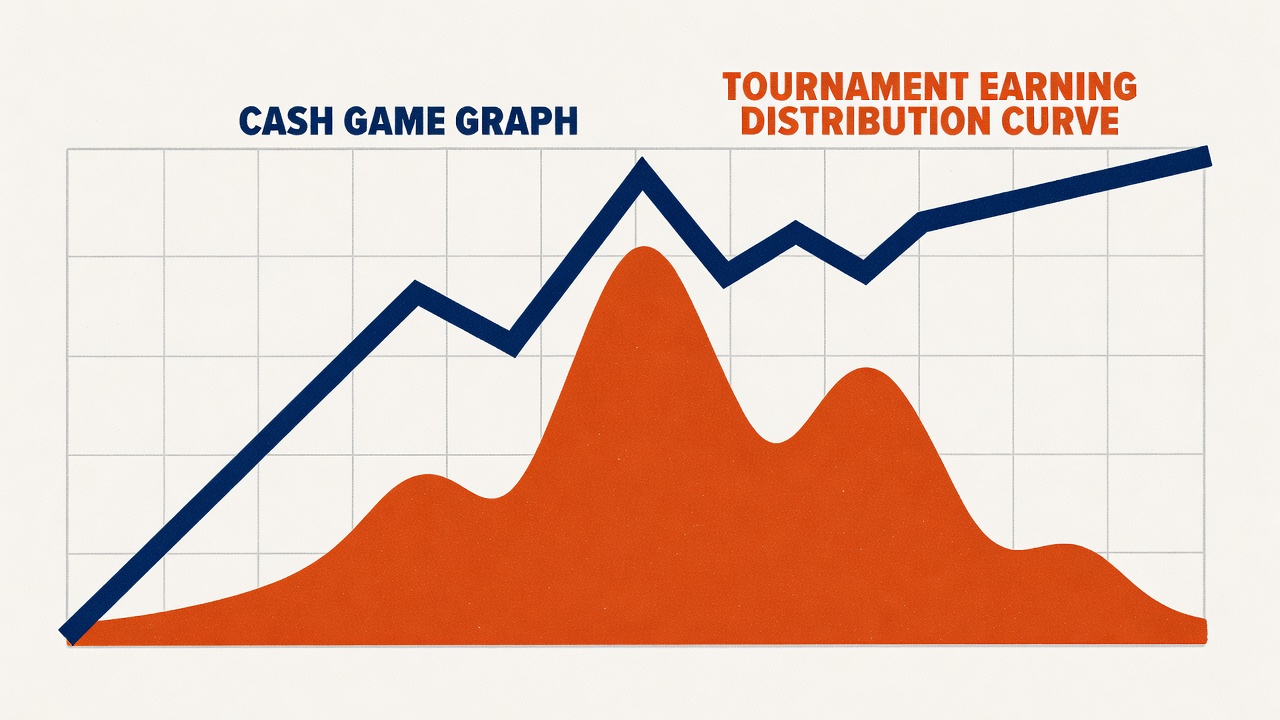
The math is straightforward: a mid-stakes cash game grinder, playing solid fundamental poker, can expect a win rate of one to two big blinds per hour. That sounds small until you compound it. Three hundred hours per month at a dollar-per-hand game grinding fifty-cent big blinds with a 1.5 BB/hr win rate nets you nine thousand dollars per month. Fifty-four thousand per year. Not glamorous, but it's rent and food and a truck payment.
Tournaments? You're buying into a thirty-person event with a thousand-dollar buy-in. Prize pool is twelve grand. You're 100/1 to win. Even if you're a crusher, if you win 15 percent of your tournaments (which would make you an absolute maniac, nearly superhuman), you're making fifteen hundred dollars per tournament on a thousand-dollar investment. That's only 500 percent ROI, which sounds great until you realize you need to play eighty tournaments just to see a five-thousand-dollar profit, and that's assuming zero variance deviation.
The Bankroll Requirement Problem
Cash games demand a bankroll, true. You need fifty to one hundred big blinds to be comfortable. But tournaments demand something worse: emotional capital and the ability to absorb catastrophic session losses that don't correlate to skill.
I watched a kid named Marcus, played at the Bike, absolutely destroy one-two cash games for nine months. Built a sixty-thousand-dollar bankroll from nothing. Got overconfident, swapped into tournament season, decided he was gonna run the circuit. Six months later, buried under variance, shipping thirty buy-ins to random coolers and tilt decisions, he was borrowing money against his car. Now he's back at the one-two game, grumbling about the quality of the player pool.
The reason is structural: cash games provide immediate feedback and reward for solid decision-making. Your hourly wage accumulates. Tournaments are a lottery with a slight skill weighting. You can make the best decision available and still brick it sixty times in a row, and your bankroll doesn't care that you were mathematically correct.
Poker is a game where the best hand wins often enough to convince you to play again, and not often enough to make you rich.
Cash games also offer flexibility. Bad run? You quit the session, preserve your bankroll, take a walk. Tournaments? You're locked in for three hours minimum, bleeding chips, watching your thousand-dollar investment evaporate to blinds while you're card-dead on the button for eighteen hands.
Now, the counterargument that tournament grinders make goes like this: yes, but if you hit that big score, if you win a major tournament, the cash-game grinder's annual earnings are irrelevant. You'd need fifteen years of solid grinding to match one eight-hundred-thousand-dollar tournament victory. Fair point. But how many tournament players are you willing to watch go broke chasing that one score? How many Poker Brats, how many WSOP bracelet holders, how many pros with Twitter followings have you seen busted out by age thirty-five?
The honest conclusion: cash games build wealth steadily and sustainably, assuming you're above average. Tournaments are a path to ruin that occasionally produces legendary stories. Choose the steady paycheck unless you have access to deep bankrolls, emotional stability that borders on psychopathic, and a genuine edge that translates across hundreds of tournaments. Most don't. Most should play cash.