One might ask: what is a transaction, if not the moment when it ceases to exist as intention and becomes fact? In traditional banking, this happens instantly. You hand money to the teller; the money becomes someone else's. The transaction is complete.
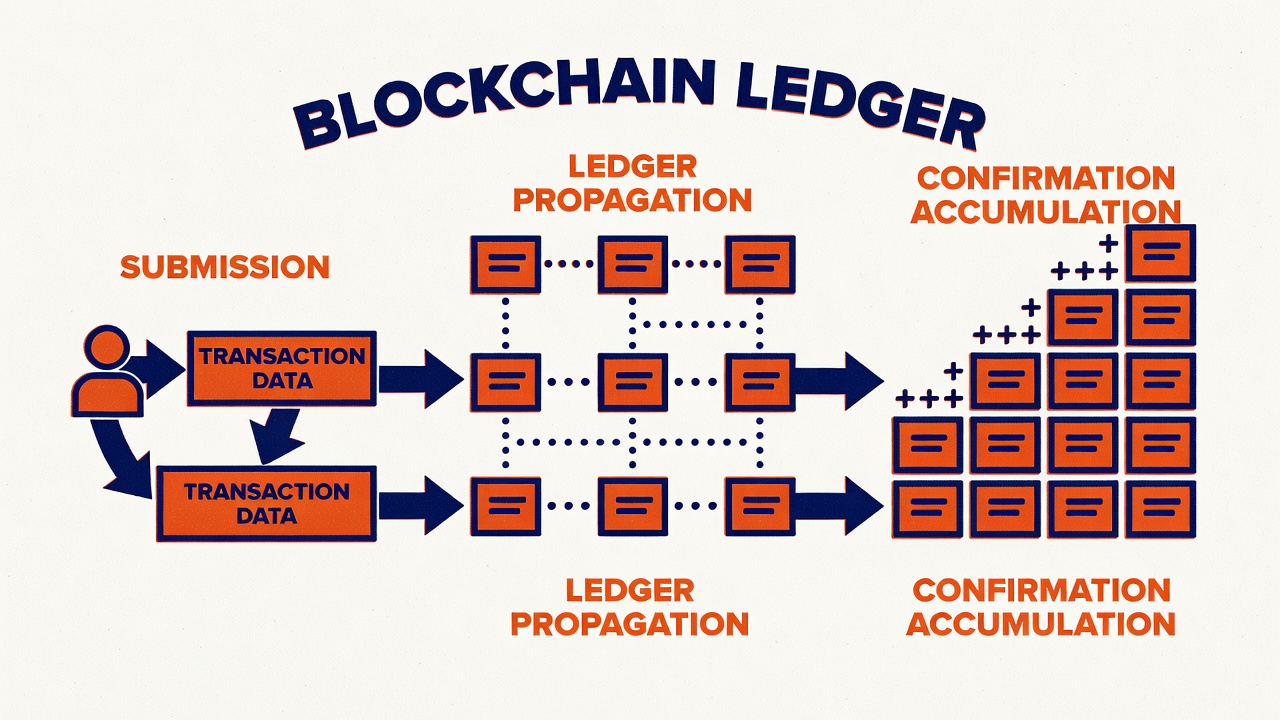
In blockchain systems, the transaction exists in a liminal state. You broadcast it to the network. It sits in a memory pool, waiting. Miners (or validators, in newer systems) notice it and include it in a block. That block becomes part of the chain. Only then does the transaction become irreversible.
So consider the blockchain transaction status. "Pending" means your transaction has been broadcast but not yet included in a block. Your money is committed from your account, but not yet committed to the recipient's. Until confirmation occurs, either party could theoretically withdraw. This is the moment of vulnerability.
The Nature of Confirmation
What is a confirmation? It is the moment when the transaction becomes part of the immutable record. The first confirmation means your transaction has been included in one block. The second confirmation means a second block has been added after the first, making it exponentially harder to reverse your transaction. The further back in the chain your transaction sits, the more certain the transaction becomes.
Bitcoin considers a transaction "confirmed" after one block has been added. Ethereum uses the same principle, though more loosely. Exchanges typically require six confirmations before crediting deposits, which represents the judgment that reversing six consecutive blocks is sufficiently improbable as to be effectively impossible.
Here we must ask: when does certainty become actual certainty? After one confirmation? After six? After a hundred? Philosophically, absolute certainty is impossible. But practical certainty, the certainty upon which commerce can operate, arrives at the sixth confirmation. By then, the computational cost of reversing the transaction exceeds its value.
The Question of Time
How long does confirmation take? This depends on the network's traffic and the transaction fee you paid. Bitcoin blocks arrive approximately every ten minutes. A transaction included in the first block after you broadcast it confirms in ten minutes. A transaction that waits for the next block confirms in twenty.
But network congestion creates delay. If many people are transacting simultaneously, the memory pool fills. Miners prioritize transactions with higher fees. Your transaction, if you were miserly with fees, waits. It might wait hours, or days.
This reveals something: certainty is a function of price. You can purchase faster confirmation by paying higher fees. The poor man's transaction waits; the rich man's transaction confirms immediately. This is a form of inequality embedded in the system itself.
The Deeper Mechanism
Why require confirmation at all? Because blockchain systems operate on distributed consensus. No single entity can declare a transaction valid. Instead, the network must agree. Blocks represent moments of collective agreement. The more blocks that pass, the more the collective has endorsed the transaction's validity.
One might therefore ask: what is money itself, if not collective agreement that something has value? In traditional systems, the central bank provides that agreement. In blockchain systems, the network provides it. Neither is more or less real; they are simply different mechanisms for achieving social consensus.
Check your transaction status using a block explorer: you will see each confirmation arrive as blocks are added to the chain. This is not mystical. It is simply the network announcing, repeatedly, that it accepts your transaction as legitimate. After six such announcements, the transaction has become fact.